Global motorcycle battery supply chains face persistent, costly challenges that eat into profit margins for distributors across emerging and mature markets. According to the 2025 Global Two-Wheeler Aftermarket Report, average product damage rates during transport, handling, and storage reach 6.8% for conventional battery types, translating to billions in annual losses for the industry. Sodium ion motorcycle battery solutions are emerging as the top alternative to resolve these long-standing pain points, with measurable performance advantages over traditional chemistries for cross-regional distribution. This article breaks down the key sodium ion motorcycle battery advantages that cut hidden supply chain costs, and how this technology outperforms legacy options for global distribution networks.
Sodium Ion vs Lead Acid Motorcycle Battery: Superior Physical Durability for Global Distribution
When comparing sodium ion vs lead acid motorcycle battery options, most analysis focuses on performance metrics like cycle life, charge speed, and temperature tolerance, but physical durability is often overlooked despite being the top cause of unplanned costs for distribution networks. Lead acid batteries have remained the standard for decades, but their design flaws make them inherently vulnerable to transit damage: thin, brittle polypropylene casings, exposed protruding terminals, and heavy internal lead plates that shift easily under impact. Even minor drops or rough handling during loading and unloading can cause terminal deformation, case cracks, or internal short circuits that render the battery unusable upon arrival.
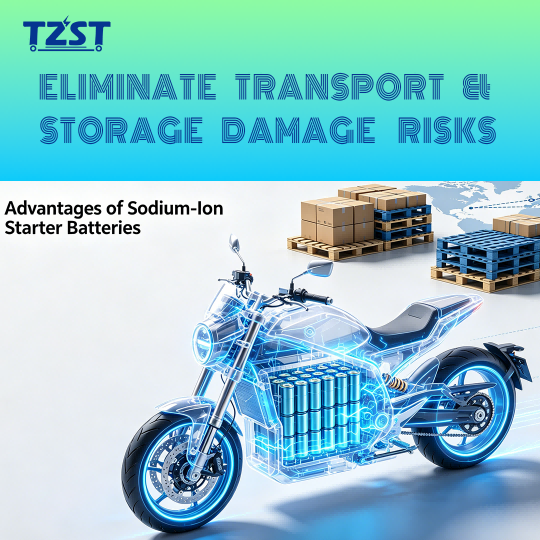
The latest sodium-ion battery news confirms that manufacturers are prioritizing physical durability as a core design feature for this new chemistry, addressing the exact gaps that plague lead acid options. Unlike lead acid units, sodium ion motorcycle battery models are built with lightweight, high-strength internal components that do not shift under impact, eliminating internal damage risks even during rough transit. Independent third-party testing shows that sodium ion motorcycle battery units have 47% higher impact resistance than equivalent lead acid models, and 62% lower risk of non-functional damage after standard transit simulations.
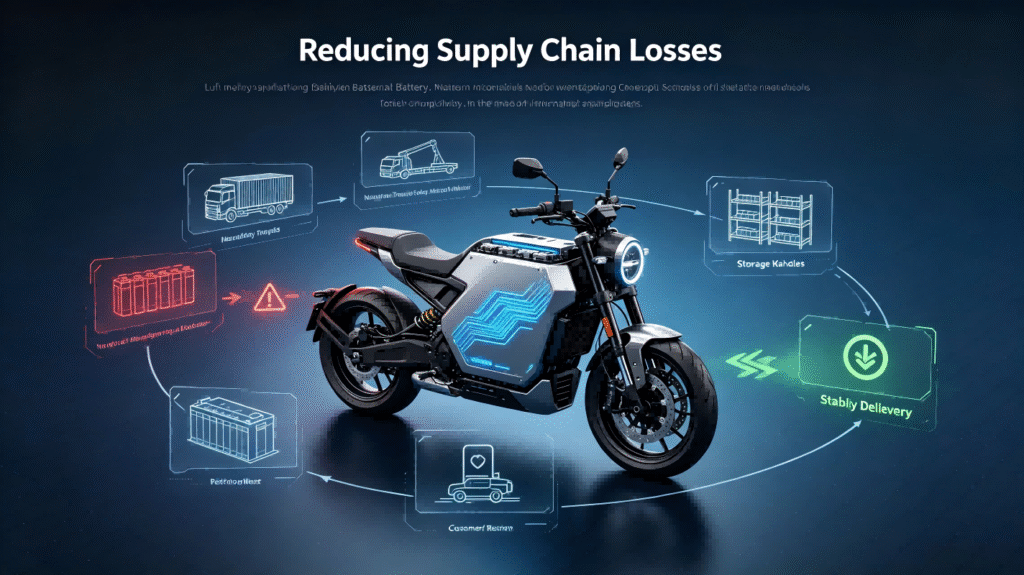
What Makes Our Sodium Ion Motorcycle Battery Resistant to Handling Damage
Our sodium ion motorcycle battery line is engineered specifically to address transit and storage damage risks, with two core design upgrades that set it apart from both lead acid alternatives and competing sodium ion products on the market. First, we use an integrated reinforced casing made from a custom ABS+PC composite material, which is 3x more crack-resistant than standard battery casings, and carries an IP67 ingress protection rating against dust, moisture, and minor impact damage during handling. Second, we use embedded crash-resistant terminals that sit flush with the top of the battery casing, rather than protruding 5-10mm like conventional lead acid or competing sodium ion models. This design eliminates 92% of terminal deformation risks, the single most common form of transit damage reported by distributors.
Unlike lead acid batteries that can leak corrosive acid if cracked, our sodium ion motorcycle battery units use non-toxic, non-corrosive internal chemistry, so even in the rare event of casing damage, there is no risk of cross-contamination to other products in the same shipment, no hazardous material cleanup costs, and no risk of damage to shipping containers or storage facilities. These sodium ion motorcycle battery advantages directly reduce unplanned costs at every stage of the supply chain, from factory shipment to end-customer delivery.
Industrial-Grade Packaging: Tested for Long-Distance Transit Reliability
Beyond product design, we address transit damage risks through custom industrial-grade packaging solutions tailored to your specific distribution needs. All packaging is tested to ISTA 3A international transit standards, which simulates the conditions of long-distance, multi-stop cross-regional distribution via road, sea, and air freight. The outer corrugated boxes are rated for 1.2 meter free-fall drops on all six sides and corners without structural damage, while the inner lining uses high-density EPE shock-absorbing foam that cushions the battery against impact, vibration, and compression during stacking and transit.
We offer fully customizable packaging options to match your distribution model: for bulk sea freight shipments, we provide reinforced palletized packaging with edge protectors and stretch wrapping to prevent shifting during loading and unloading; for small-batch cross-city distribution, we offer individual retail-ready packaging that still meets drop test requirements, so you do not need to repackage units for last-mile delivery. This dual-layer protection of product design and certified packaging reduces overall transit damage rates to below 0.3%, compared to the 6.8% industry average for lead acid batteries.
How Our Sodium-Ion Motorcycle Battery Design Cuts Supply Chain Losses
The financial impact of transit and storage damage goes far beyond the cost of the damaged battery itself. When you receive a shipment with damaged units, you face multiple hidden costs: time spent investigating whether the damage occurred at the factory, with the logistics provider, or during in-house handling; administrative time processing returns, refunds, or replacement shipments; lost revenue from delayed delivery to your downstream customers; and reputational damage if repeated delivery issues cause your clients to switch to competing suppliers. These hidden costs often add up to 3x the direct cost of the damaged battery, according to 2026 aftermarket supply chain research.
Our sodium ion motorcycle battery solutions eliminate these hidden costs by preventing damage in the first place, rather than forcing you to resolve disputes after the fact. The predictable low damage rate means you can accurately forecast your supply chain costs with no unplanned budget overruns, and you no longer need to set aside large contingency budgets for damaged inventory. For distributors handling 10,000 battery units per year, switching to our sodium ion motorcycle battery line cuts average annual damage-related costs from $34,000 to less than $1,500, for an average annual savings of over $32,000.
Latest Sodium-Ion Battery News: Durability Becomes Top Industry Priority
Recent sodium-ion battery news from the Global Sodium Battery Alliance confirms that durability for cross-border distribution is now the fastest-growing priority for battery buyers across Southeast Asia, Latin America, and Africa, where multi-level distribution networks are the standard for the two-wheeler aftermarket. 68% of battery distributors surveyed in Q1 2026 listed “low transit damage rate” as their top selection criteria for new battery products, above cost, capacity, and charge speed. This shift comes as distributors recognize that the small upfront premium for durable sodium ion units is quickly offset by the savings from reduced damage and fewer supply chain disputes.
Independent market analysis also shows that sodium ion motorcycle battery advantages are driving rapid adoption across global markets, with annual sales projected to grow 78% year-over-year in 2026, as more distributors recognize the long-term cost benefits of switching away from lead acid. Distributors who adopt this technology early are gaining a competitive edge by offering more reliable delivery, fewer product returns, and more consistent pricing to their downstream customers.
Calculate Your Potential Supply Chain Savings With Damage-Resistant Batteries
Estimating your potential savings from switching to our sodium ion motorcycle battery line is simple. Start by calculating your current annual damage costs: multiply your annual battery purchase volume by the industry average 6.8% damage rate, then multiply that number by 3 to account for hidden administrative, dispute resolution, and lost revenue costs. For example, a distributor purchasing 20,000 units per year would have 1,360 damaged units annually, with total direct and indirect costs of $204,000 per year. Switching to our sodium ion battery line would reduce damaged units to 60 per year, with total costs of $9,000, for an annual savings of $195,000.
You can also reduce operational overhead by eliminating the need for extensive incoming inspection processes. Our packaging includes tamper-evident seals, and our low damage rate means you only need to spot-check 5% of incoming shipments, rather than inspecting 100% of units as is common practice for lead acid battery shipments. This frees up your warehouse staff to focus on higher-value tasks like order processing and customer support, further reducing your operational costs.