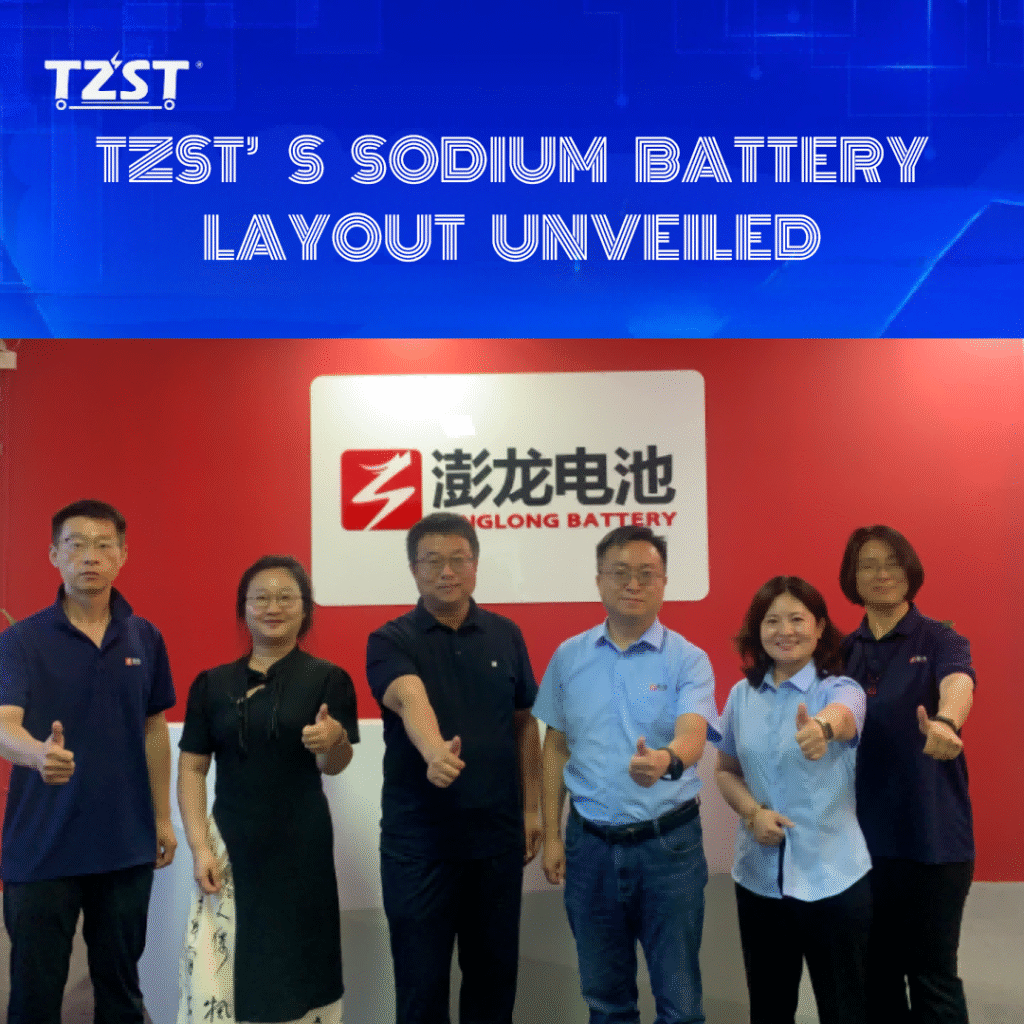
This Cold Region Truck Battery Tech Collaboration is a tripartite industry-university-research joint project launched by TZST, Tianjin University of Technology and Siberian Federal University. Recently,TZST Electech Co., Ltd. joined hands with Tianjin University of Technology and Russia’s Siberian Federal University to officially launch a full-chain joint research project on sodium and lithium-ion starting power supplies for heavy-duty trucks in extremely cold regions. Relying on the complementary advantages of the three parties in industrial resources, domestic university research, and Russia’s top cold-region research platforms, the project will tackle the “bottleneck” technical problems of intelligent management and control of vehicle-mounted batteries in cold regions, and open up a complete channel from algorithm research and development, prototype verification to overseas industrialization.

Focusing on Pain Points of Extremely Cold Scenarios, Building a Complete AI-Driven Battery Thermal Management Technology System
The northern regions of China and Siberia, Russia have long winters and extreme low temperatures. Sodium/lithium-ion starting batteries supporting heavy-duty trucks, logistics commercial vehicles, and engineering equipment have long faced multiple industry pain points: insufficient battery state perception accuracy at low temperatures, significant output power attenuation, excessive active heating energy consumption, poor cell temperature consistency, and inability to identify thermal safety hazards in advance, which seriously restrict the stable operation of commercial vehicles in cold regions. To address these industrial challenges, the three-party team has built a full-chain research system of “AI state perception – deep learning state prediction – AI adaptive thermal management control – intelligent safety early warning – industrial prototype system integration and verification”, focusing on developing intelligent adaptive heating management and control technology for sodium-ion batteries adapted to extremely cold working conditions, and forming a standardized, engineerable complete technical solution for starting power supplies of heavy-duty trucks in cold regions.
Complementary Advantages of the Three Parties, Creating a Cooperation Paradigm of “Industry + Domestic Universities + Top Russian Cold-Region Research Institutes”
TZST Electech Co., Ltd.: Core Carrier for Industrialization of Sodium-ion Batteries. As a pioneer in the engineering application of sodium-ion batteries in China, the company has deeply engaged in R&D and manufacturing of vehicle-mounted intelligent starting power supplies, and has achieved fruitful results in industry-university-research collaborative layout. The company has jointly built a postgraduate internship and practice base for battery intelligent safety and a Tianjin University of Technology-TZST Battery Joint Research Laboratory with Tianjin University of Technology; the “A Battery State Estimation Method, System and Medium” jointly developed by the two parties from 2024 to 2026 was granted a Chinese national invention patent on March 20, 2026. The sodium-ion starting power supply developed in 2025 has obtained export certification from Tianjin Free Trade Zone Customs, and is sold to Africa and Southeast Asia. It is the first sodium-ion battery product in northern China to achieve export, and relevant results have been featured in special reports on official platforms of Tianjin Municipal Government. Currently, the company is fully expanding the vehicle-mounted power supply market in cold regions of Russia and Central Asia. The technologies developed in this project can be directly transformed into mass-produced battery products exported overseas, forming a two-way closed loop between scientific research results and overseas market demands.

Professor Xu Liang’s Team from Tianjin University of Technology: Core Domestic R&D Force for AI Battery Algorithms
Tianjin University of Technology has been deeply engaged in disciplines such as electrical engineering, artificial intelligence, and new energy intelligent control for many years, with complete disciplinary platforms. The research team led by Professor Xu Liang has long focused on R&D of battery state estimation, battery management systems, multi-source data fusion, and embedded vehicle-mounted control systems, providing complete technical reserves for AI perception, deep learning prediction, intelligent thermal management, and fault early warning algorithms of this project. The team has previously completed a series of basic research including battery operation data collection, SOH health assessment, SOC charge estimation, low-temperature characteristic analysis, and intelligent fault diagnosis, accumulated mature algorithm models, measured data sets, engineering software and industrialization experience, supporting the R&D of intelligent management and control technology for low-temperature batteries in cold regions.
Introduction of Core Chinese Expert: Professor Xu Liang, Doctoral Supervisor
He holds a Doctor of Engineering degree from Xi’an Jiaotong University and a postdoctoral degree in Computer Science and Technology. In 2024, he was selected into Stanford University’s “Top 2% Scientists in the World” list, and was awarded the title of Excellent Postgraduate Supervisor of Tianjin in 2022. He has presided over 2 National Natural Science Foundation projects, first-class funding from the China Postdoctoral Science Foundation, Tianjin Major Science and Technology Special Projects and other national and provincial-level scientific research projects; he has applied for 13 invention patents, published more than 80 high-level academic papers, and published 1 monograph by Science Press, with profound academic influence in the field of vehicle-mounted energy storage intelligent algorithms.

Siberian Federal University: Global Benchmark Platform for Extreme Cold Battery Research
Siberian Federal University is a top 15 federal-level national university in Russia, the highest scientific research and education center in Siberia. Located in the core area of extreme cold in Eurasia, it naturally has real-vehicle testing conditions with long-term low temperatures and harsh climates, and is a typical test base for global cold-region transportation energy equipment research. The Russian team led by Professor Oleslav Alexandrovich Antamoshkin has a Russian national-level extreme cold vehicle-mounted battery testing platform, and is one of the few scientific research teams in Russia with the ability to conduct long-term field real-vehicle verification of heavy-duty truck batteries, focusing on low-temperature energy storage mechanisms and energy systems of cold-region equipment; the university’s Laboratory of Hybrid Modeling and Optimization Methods for Complex Systems is a world-class scientific research platform, specializing in AI algorithm design, electro-thermal coupling modeling, and multi-parameter intelligent optimization, which can greatly improve the stability and versatility of battery AI models under extremely cold and complex working conditions. The team also has strong scientific research capabilities in interdisciplinary fields such as mathematical modeling, industrial intelligent decision-making, data analysis, and computer vision.
Introduction of Core Russian Expert: Professor Oleslav Alexandrovich Antamoshkin, Doctor of Engineering
He is the academic leader of energy storage and intelligent control at Siberian Federal University, an authoritative expert in the field of cold-region battery management systems (BMS) and low-temperature energy storage algorithms in Russia. He has convened the All-Russian Academic Symposium on Low-Temperature Energy Storage and BMS for three consecutive years from 2023 to 2025, and presided over a number of Russian national-level low-temperature energy storage special projects. Since 2021, he has published 56 papers in top journals such as IEEE and Journal of Power Sources, owns 18 software copyrights and a Russian patent for heating control of low-temperature lithium-ion starting batteries, and his research results are included in Scopus, Web of Science, and the Russian Science Citation Database.
Project Value Outlook
This tripartite cross-border joint R&D opens up a new cooperation model of “Chinese enterprise industrialization platform + domestic university AI algorithm R&D + Russian extreme cold testing and verification”. The R&D results of the project can not only solve the technical bottlenecks of commercial vehicle power supplies in cold regions of northern China, but also meet the market demands of Russia and Central Asia, promoting the international output of domestic sodium-ion battery intelligent management and control technologies.