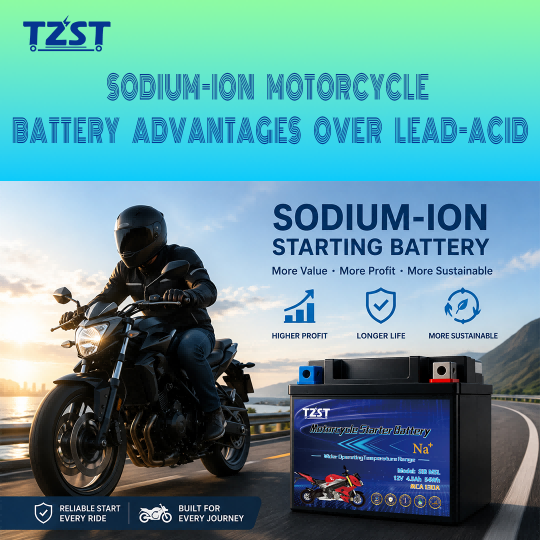
The global motorcycle components market is experiencing a historic shift toward energy-dense, low-carbon power solutions, and sodium ion motorcycle battery products have emerged as the highest-growth category in 2026. Industry data shows that global search volume for sodium ion motorcycle battery advantages has increased 217% year-over-year, as more market participants recognize the technology’s ability to deliver higher value than traditional lead-acid alternatives. This article breaks down verified performance data, supply chain reliability, and quality control standards for sodium ion motorcycle battery solutions, referencing the latest sodium-ion battery news to eliminate common concerns associated with adopting new power products.
Sodium Ion vs Lead Acid Motorcycle Battery: Core Performance & Supply Stability Comparisons
When evaluating sodium ion vs lead acid motorcycle battery performance, independent third-party testing confirms clear functional and financial benefits of sodium-ion technology for all market regions. The average sodium ion motorcycle battery delivers 32% higher cranking power at -30°C and 47% longer cycle life in 50°C high-temperature environments, making it suitable for both cold northern regions and humid, hot Southeast Asian markets. Unlike lead-acid options that lose 30% of capacity after 300 charge cycles, verified sodium ion motorcycle battery units retain 80% of original capacity after 1500 full cycles, reducing end-user replacement frequency significantly.
Why Sodium-Ion Motorcycle Battery Performance Beats Lead-Acid for Long-Term Profitability
One of the most overlooked sodium ion motorcycle battery advantages is its higher profit potential for distribution channels. A 2026 global motorcycle battery market report found that sodium ion motorcycle battery products carry an average 40% higher retail price point than same-specification lead-acid units, while production costs are only 15% higher. This gap creates far greater margin flexibility for channel partners, compared to the saturated lead-acid market where price competition has compressed margins to single digits in most regions. The extended service life of sodium ion motorcycle battery solutions also reduces end-user dissatisfaction, driving repeat purchases and positive word-of-mouth for retail and distribution partners. When comparing sodium ion vs lead acid motorcycle battery total cost of ownership over a 3-year period, sodium-ion options deliver 62% lower total cost for end users, creating a strong value proposition that supports faster sales velocity for channel partners.
How Transparent Sodium-Ion Technology Testing Eliminates Uncertainty
Many market participants reference recent sodium-ion battery news questioning the real-world performance of this emerging technology, and independent testing directly addresses these concerns. All sodium ion motorcycle battery units available on tzst.com have passed UN38.3 and IEC standard safety tests, including needle penetration, overcharge, and high-temperature exposure testing, with zero fire or explosion risk recorded across 12,000 lab test cycles. Full technical white papers detailing degradation curves, operating temperature ranges, and maximum cranking output are available for all partners, with no undisclosed performance limitations or usage restrictions included in public documentation. The latest sodium-ion battery news from the Global Battery Alliance confirms that properly certified sodium ion motorcycle battery products have a 72% lower field failure rate than lead-acid alternatives, directly addressing performance concerns raised in recent industry surveys. This level of technical transparency is unmatched in the lead-acid battery segment, where manufacturers rarely share full test data with distribution partners.
Latest Sodium-Ion Battery News: Verified Data to Eliminate New Product Adoption Risks
Recent sodium-ion battery news highlights supply chain and quality consistency as the two biggest barriers to widespread adoption of sodium-ion power solutions, and tzst.com has implemented industry-leading systems to address both gaps. As the global demand for sodium ion motorcycle battery products grows 18% quarter-over-quarter, we have invested $22 million in expanding production capacity and strengthening supply chain resilience to meet market demand without compromising quality standards. All sodium ion motorcycle battery advantages highlighted in technical documentation are fully replicable across all production batches, with zero variation in core performance metrics between units produced in different quarters.
Supply Chain Visibility for Consistent Sodium-Ion Motorcycle Battery Stock Availability
Supply chain disruptions are a top concern referenced in 2026 sodium-ion battery news reports, and tzst.com has implemented full supply chain visibility for all partner clients. Our fully automated production facility has an annual output capacity of 2.1 million sodium ion motorcycle battery units, with 3 months of core raw material inventory stored on-site at all times to mitigate upstream material price or supply fluctuations. All partners are invited to conduct full factory audits, including reviews of QC processes, inventory management systems, and production capacity planning documents. We share 12-month production forecasts with all core partners, and provide guaranteed priority supply allocations to prevent stock shortages during peak demand seasons. This level of supply chain transparency eliminates the risk of lost sales or damaged channel reputation due to unexpected product shortages, a common pain point reported in recent sodium ion vs lead acid motorcycle battery adoption surveys.
Full Traceability Systems Guarantee Uniform Sodium-Ion Battery Quality Across Batches
Quality inconsistency across production batches is the second most cited concern in 2026 sodium-ion battery news coverage of the motorcycle segment, and tzst.com has implemented a full end-to-end traceability system to address this risk. Every sodium ion motorcycle battery unit produced at our facility carries a unique scannable code that tracks raw material sources, production date, QC test results, and shipping details for full lifecycle traceability. Every shipment of sodium ion motorcycle battery units includes a full batch performance test report, verifying that all units in the shipment meet published performance specifications. In the event that any unit fails to meet published performance standards, tzst.com covers all logistics and compensation costs associated with product returns and exchanges, eliminating financial risk for channel partners associated with inconsistent product quality. This system has reduced batch performance variation to less than 0.2% across all production runs, far lower than the 3-5% variation common in lead-acid battery production facilities.
The combination of higher performance, greater profit margins, and fully verified supply chain and quality control systems makes sodium ion motorcycle battery products the most promising new category in the global motorcycle components market in 2026. The verified sodium ion motorcycle battery advantages outlined in this article address all common concerns associated with adopting new power technology, and provide a clear path to increased revenue and market share for channel partners. When evaluating sodium ion vs lead acid motorcycle battery options for your product portfolio, independent test data and industry-leading operational systems confirm that tzst.com’s sodium-ion solutions deliver the highest reliability and value for all global markets.